%20FRW%20FINAL%20LOGO-01.png)
A 130-Year-Old Bridge. Remote Tasmania. Live Trains Still Running.
Most jobs don’t start like this.
Forty minutes into the remote Tasmanian wilderness, standing on a heritage-listed railway bridge built in the 1890s, above moving water with passenger trains still scheduled to run. No road access. No phone reception. No room for error.
This wasn’t just another project for West Coast Wilderness Rail. They needed structural strengthening work completed on their 46m bridge without shutting down operations or compromising a structure that had stood for over a century.
That’s where FRW Industrial came in.


Photo: Tourism Tasmania & Rob Burnett
On paper, the scope was clear: remove 400 original rivets, install new bracing cleats, complete structural upgrades, and ensure everything met current engineering standards. In reality, it was far more complex. Every day started the same way, getting a small crew of six into site via Hi-Rail, working within strict load limits, and setting up on a bridge with no edge protection and minimal working space.
And then there was the timing. Because this wasn’t a shutdown project. Trains were still running. That meant every task had to be carefully sequenced around live rail movements. Once work began on critical elements, such as removing the original 1890s rivets, it had to be completed before the next train passed. No delays. No second chances.

.jpg)
Scaffolding wasn’t viable. The additional weight alone would have created structural risk. Elevated work platforms couldn’t access the site. And with no road access, even getting equipment in was a challenge. This wasn’t a job where you could force a standard solution to fit. It needed a different approach.
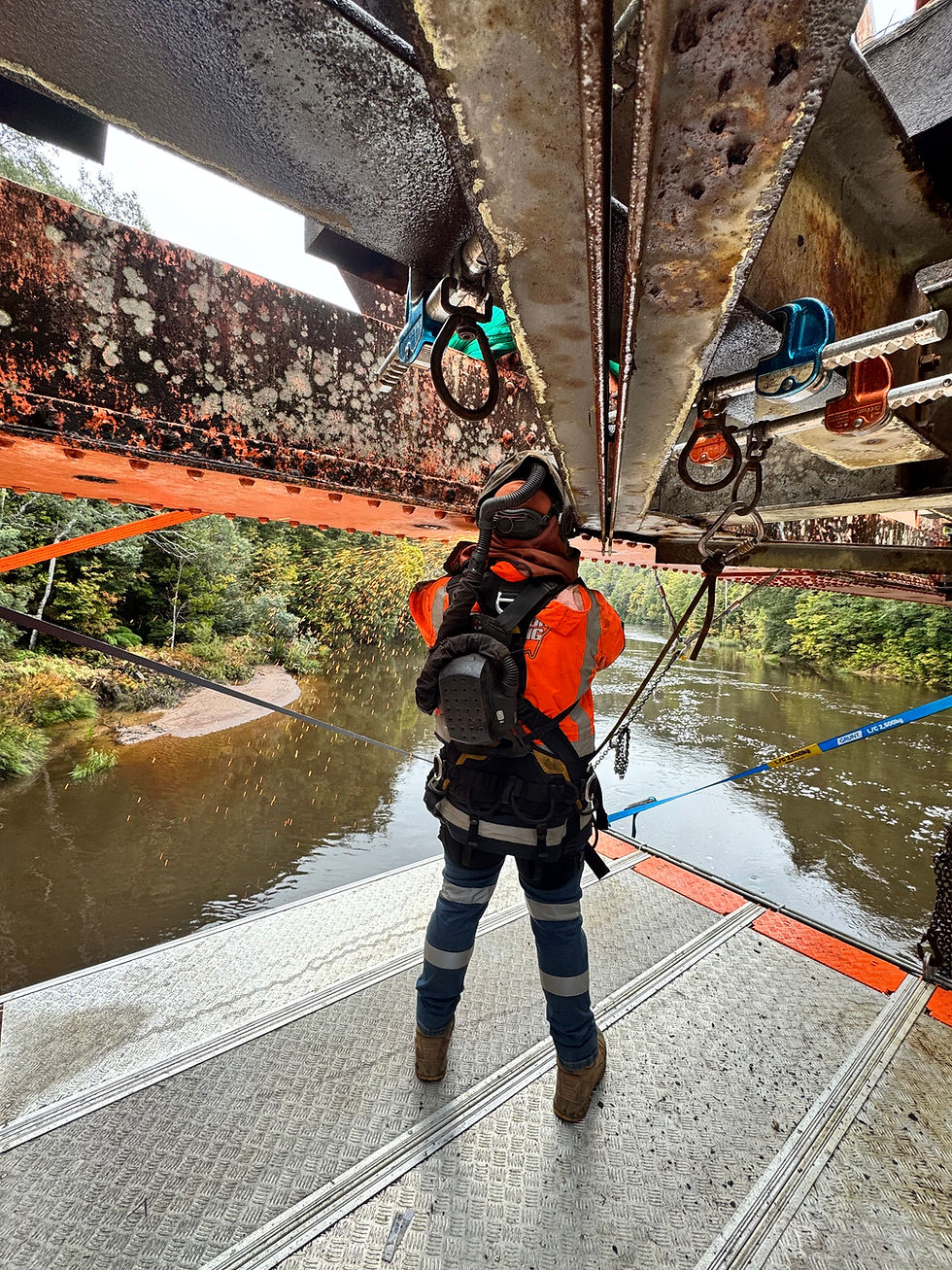
FRW deployed a modular V-Deck system, a lightweight platform installed entirely via rope access. Piece by piece, suspended by ropes, the team built a stable working platform beneath the bridge without adding unnecessary load or disrupting the structure. Once a section was complete, the system didn’t come down. It moved. Bay by bay, the team leapfrogged the platform across the bridge, maintaining efficiency while keeping the setup intact. It wasn’t just faster, it made the job possible.
.jpg)
This was never just about getting people into position. Once the team was under the bridge, the real work began and it was highly skilled, highly technical work that demanded patience, precision, and the right people on the ropes.
The original rivets that had held the structure together since the 1890s needed to be carefully removed without damaging the surrounding steel. New bracing cleats then had to be installed, aligned to match the original structure, and secured exactly to specification. From there came the bolting, torqueing, welding, and mechanical works, each step relying on the one before it being done properly.
What made it even more demanding was the environment in which the team was working. They were suspended above water, exposed to the weather, and operating within narrow windows between live train movements. There was no luxury of slowing the whole site down or simply picking the job up again later if something went wrong.
Even the smallest detail could affect the day. A failed cutting tool wasn’t a minor inconvenience out there. It could cost hours, and hours were something the team didn’t have. That meant every part of the operation, from equipment selection to work sequencing, had to be thought through in advance.
Nothing about it was rushed. It was planned carefully, executed methodically, and carried out by technicians who understood that on a job like this, precision isn’t a bonus, it’s the job.
The environment never really gave the team a break. Most days brought rain, and with it came the added pressure of rising water levels, slippery surfaces, and the constant need to reassess conditions. At the same time, the realities of working in remote Tasmanian wilderness meant dealing with whatever came with it, from difficult terrain to the unpredictability of the surroundings.
From the start, we knew that access to the right equipment would be difficult in this setting. The solution would be straightforward. Bring in what you need and keep moving. Out here, it wasn’t that simple. We coordinated to bring a fully equipped truck onto the bridge using a rail carriage. It had been mapped out from day one, but it was exactly what the job required. The kind of decision that only comes from experience.
By the time the project was complete, more than 5,000 hours had been spent on site. Over that time, no incidents or near misses were recorded. That outcome wasn’t luck, and it wasn’t a coincidence. It was the result of careful planning, well-established systems, and a team that understood exactly what was at stake every time they stepped onto the structure, working at height, above water, in a live rail environment where there was no margin for complacency.
In the end, the project was delivered on time and under budget, and completed roughly half the time expected using more traditional methods. But beyond the numbers, what mattered most was what didn’t happen. Operations continued without disruption. Passengers still experienced the journey as planned. The bridge remained functional throughout, and the work was completed to a standard that will stand the test of time.
Looking back, this project was never just about access. It was about taking full ownership, from the early planning stages through to the final execution and making sure every part of the job was handled properly. It required more than technical capability. It required coordination, trade expertise, and the ability to make the right calls when conditions changed.
Because on a job like this, there’s no room for average.
Some projects look impressive when they’re finished, but this one is better understood by what it took to get there. When access is difficult, conditions are unpredictable, and failure isn’t an option, you need more than a contractor.
You need a team that knows how to plan, adapt, and deliver.